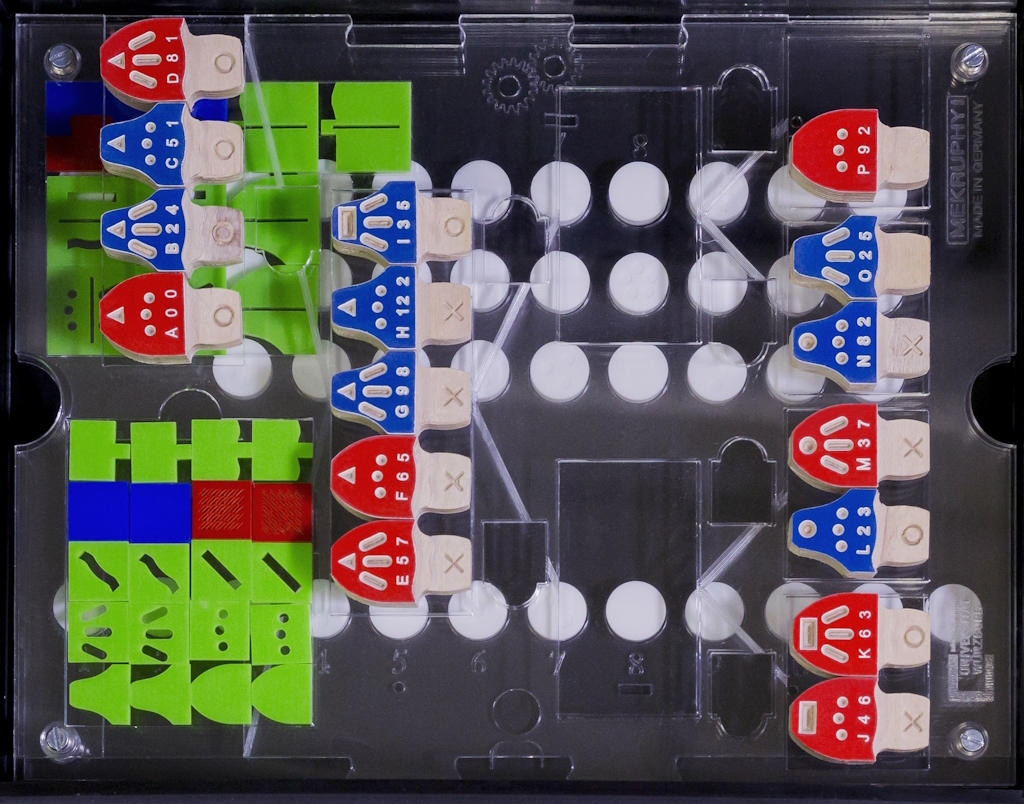
The availability of large datasets, combined with increasingly powerful computers, has recently fueled the rise of Artificial Intelligence (AI) and enabled unprecedented developments – with all the associated opportunities and risks. This trend is also reflected in the curricula of many German federal states, where the topic of AI has already been introduced. As a result, there is an urgent need among teachers, which we aim to address with our experiment set.
School Practice Combined with the Latest Scientific Insights
We were able to partner with the University of Würzburg: In collaboration with Dr. Silvia Joachim (Computer Science Didactics, University of Würzburg), who has extensive experience in school practice, we developed an experiment set that can be used in several grade levels depending on the curriculum and school type, providing a practical approach to the new curriculum topic.
Wide Range of Experiments for Different Age Groups
The “AI Wins” game serves as an introductory experiment that not only provides a playful entry but also offers the fascinating opportunity to observe the “AI system” learning, round by round. Far from the screen and computer, it becomes clear that there is no hidden program in the background; instead, it’s a purely systematic approach that leads to results! This not only contributes to understanding but also helps “demystify” Artificial Intelligence and lays the foundation for a factual and experience-based approach to the topic.
Through the wooden mushrooms, which feature various visible and tactile – binary and numerical – characteristics, students learn the fundamental principles of different algorithms: They create a decision tree with an algorithm and mathematically verify it using the mushrooms, which thus become a bridge between empirical experimentation and precise calculation.
The classification into training, validation, test, and decision mushrooms allows for the optimization and testing of various models. The number of mushrooms was chosen to allow for both hands-on experimentation and the optimization of hyperparameters. The coordinates of the mushroom collection sites visually explain the k-nearest-neighbor algorithm and the perceptron. Differentiation options expand the range of experiments to more advanced tasks for upper-level students.
Computer Science Meets Ethics
The real-world connection of the partially edible and partially poisonous mushrooms also highlights the ethical dimension: How far can/should one trust an algorithm (e.g., a mushroom-recognition app), and what responsibility does one take for oneself and others? How dangerous is Artificial Intelligence? Who is liable for errors?
Accompanying Materials
Carefully prepared and practically tested experiment books and teacher guides ensure a relaxed work environment and experimentation without extensive preparation – even for spontaneous lessons. Depending on the age group, school type, and curriculum, students can engage in progressive learning games and experiments, or specific tasks can be selected and adjusted according to the differentiation options.
Also for Students with Visual Impairments
Tactile features on the game pieces, wooden mushrooms and recessed areas in the decision tree module, as well as non-slip, stable base plates provide students with visual impairments with a “tangible” approach to the topic, even in inclusive classrooms. High-contrast, pleasantly tactile surfaces create a stimulating learning atmosphere through their “inviting character,” while also fostering a positive learning effect for “sighted” students.
Press Reports